Showing posts with label Jeonju. Show all posts

Sunday, November 6, 2011

FiMyMaTheMo

 or, "How My Master's Thesis Ruined My Life."


Many of you know that both Rebecca and I had finished the coursework for our respective MAs before we left the US for Korea. We both had also made significant headway on our theses before we shipped out - Rebecca had turned in a full draft of hers, and I had defended my prospectus and been given the green light to finish my analysis (which should have been the easy part). We got on the plane with laptops and backpacks full of data, and plans to finish up and defend in the summer. 


Once we got here, all that changed. We had new jobs to figure out, new foods to try, a new city to explore, and a new language to learn. We left the frozen wastes of Wyoming while it was still wintery and arrived here in time for the full bloom of spring, the season that many consider the most beautiful in Jeonju. We just couldn't sit in front of computers everyday while everything was green and flowering outside. Slowly, we let go of our summer graduation plans, and set our sights on December. 


We established a schedule that called for us to rise each day at 8:00AM and dedicate hours to our theses before working out, showering, and heading in to work at 2:00PM. This meant returning home after work and basically heading straight to bed, which is completely counter to my natural rythms. We were quite dedicated to this schedule for a time, but then we met and befriended other ex-pats in Jeonju, and like us, they got off work late in the evening. Going out for dinner with friends until 1:30AM makes it hard to get up at 8:00AM and generate quality academic writing.


Local friendships led to us becoming more active in the Jeonju internet communitites, which led to volunteering at orphanages, a Dinner in English group, and the final straw - taking a Korean class at Chonbuk University. The class met daily, and moved quite quickly. Eventually, trying to keep up with the new grammar and vocabulary was taking up all of my spare time. Everything else fell off (including posting to this blog), and soon I realized that three weeks had passed without me even looking at my thesis. 


My thesis glares at me from a dark corner of my mind constantly, like an ugly and unloved doll on a dusty shelf. I know that I should fix it up and get it ready to present, but there is always something newer and shinier clamoring for my atention. In the light of my new suroundings and new interests it seems ill-concieved, trivial, unneeded, and broken somehow. Yes - my thesis now lives on the Island of Misfit Toys, and my intended graduation date has slipped away to next May.


Although I have embraced every distraction that has come my way, I have finally realized that my unfinished thesis is sucking all the joy from my life. In my college career I never failed to turn in a paper and I never took an incomplete, so the thesis dragging on feels like a huge failure. I have reached the point where every moment of free time that I spend doing anything else, no matter how important or valid it is, is tainted because the thesis is not done. Everything - volunteering, movies, shopping, hiking, clubbing, literally everything we do for fun - reminds me that I have the debt from a Master's degree, but not the diploma. It is beginning to keep me from sleeping - I have dreams in which I face a committee that demands my paper, but there is nothing in my folder but old bus tickets and empty gimbap wrappers. This must end.


I have several friends who participate in NaNoWriMo (National Novel Writing Month) every year. They crank out around fifty or sixty thousand words in 30 days each November. I don't need anywhere near 50K - I'm just about thirty pages from done. Another form of inspiration comes from Jillian Venters of Gothic Charm School (she is inspirational in so many way) who has declared this to be her "Finish the Damn Novel Month." So, to keep myself from descending any further into this pleasureless spiral of avoidance and annoyance, I have declared November to be "Finish My Master's Thesis Month." We shall call it "FiMyMaTheMo."


I am done with Korean class and I am returning to a strict schedule of writing 5 days per week. I will allow myself to play on the weekends only if I have put in the time Monday through Friday. Let this serve as notice to my friends - I will be turning down any new social engagements during the week and staying in my cell until it is done (I am still having midnight pancakes this Tuesday with the cool kids from Junghwasan-Dong because it is already on the calendar - but after that I'm like a nun).

This should allow me to finish the damn thing by December 1st. I will not be able to put together a defense before the university goes on Winter break, but I should be able to corral my committee sometime in January or February. Hopefully by my birthday in March it will all be just an awkward memory.

After that, I will be free again. Food and friends will be guiltless again, and I will enjoy the sleep of the righteous (or at least the sleep of the exhausted teacher, which I heartily deserve). The writing project that Rebecca and I have been discussing can get underway, and perhaps I will finally have time to sign up for Taekwondo or Hapkido classes like I had planned when we first got these jobs. 

Wish me luck, and don't invite me to anything cool for a while...

Wednesday, June 22, 2011

6.22.11 Thinking on the Run

Running is not a common activity here. The few Koreans who run generally go to a track or they run on a treadmill at the gym. They don't run at night, and they don't usually run without wearing visors, masks, long sleeves, gloves, and track pants to protect them from the sun. They certanly don't stick their hairy legs in a pair of shorts, put on Vibram Fivefingers (AKA "Gorilla Feet") and pound the pavement at 11:30PM with a hyperactive Jack Russell.

While doing just that tonight, something very odd occurred to me. I am more comfortable being an alien.

Back in the US, I was a native but an outsider (note: uber-liberal Buddhists should not go to school in Wyoming, regardless of how afordable the tuition is). I knew that the bulk of the people around me saw me and the few folks like me as wrongheaded, unrealistic, helbound, and/or socialist/communist/fascist etc. In some circles, my kilt wearing even branded me a deviant. I alternated between trying to be an ambassador for the worldview I believe in, and ranting at the ignorant, discompassionate, and outright stupid prevailing mindset of the locals.

Ok, I admit that mostly I ranted, but at a certain point I realized that all the anger just made me a focus for essentialism, and then I felt obligated to try to be a better representative of my side. For me, that involved a lot of teeth gritting and counting to ten as people around me espoused all manner of bigoted and ill-informed tripe. It was exhausting, ultimately futile, and I didn't care for the vigilant/defensive posture it forced me into. In short, it was untenable.

In Korea, however, I am relieved of all that. With my blonde hair, blue eyes, and 2XL shirt size I am clearly, visibly, an outsider, and thus no one expects me to know all of the rules or behave in the conventional manner. In fact, their expectations are so low that I get major brownie points every time I demonstrate even the most rudimentary understanding of Korean language or culture. In a shop or a restaurant, if I manage any Korean beyond hello or goodbye, I get a surprised smile and doting service. If I remember to bow slightly and offer payment with both hands then I am treated with the utmost politeness - even if I drank from the fingerbowl and used chopsticks to eat rice (the latter is apparently very rude... sometimes. We still aren't clear on this one).

It may be a sad commentary on the behavior of other Westerners who came here before us, but is remarkably freeing to know that your behavior is expected to be odd. To most Koreans we are just another couple of crazy waygookin teachers. To the shopkeepers in our neighborhood, we are the Americans with the spastic dog. Either way, we stand comfortably outside the rules. As long as we make even minimal attempts to assimilate, we are accepted as we are. It allows me to be myself in a way I never felt able to pursue in the US. I had to leave home to feel at home.

Tuesday, June 14, 2011

6.14.11 Consider yourself well in...

When you hear the word "orphanage" you probably think of a curly-haired kid named Annie, or maybe Oliver Twist and the Artful Dodger. Since orphanages have all but disappeared in the U.S. in favor of group homes and foster care, the romanticized musical theatre versions of these characters are all that most Americans know of orphans. In Korea, however, orphanages are still common. Rebecca and I volunteered at an orphanage in Jeonju last Saturday. I'm not sure what I was expecting, but the whole experience was surprising.

There were none of the deprivations of orphanage life that you might expect. All of the 40 or so kids we saw were well fed, clean, and comfortably dressed. As with any group of children there was the 5% who are either crying or refusing to cooperate, but the majority of the kids were great - happy, friendly, and glad to be playing outdoors in the sun. Ordinarily, we would have taken pictures, but photography is prohibited to protect the kids' identities.

We played kickball, dodgeball, and had some three-legged races with the kids, then finished up with a balloon stomp.  A few had some pretty annoying behavioral problems; aggressive and recalcitrant, they attempted to run all of the activities to their liking. All of the games invovled significant cheating and an uncomfortable amount of bullying. I imagine this is an outgrowth of the orphanage lifestyle. It seemed there was a clear-cut pecking order beyond the normal stratification of kids by age and gender. There was one boy in particular who seemed to be the boss of the place, and he ruled by threats that he seemed willing to back up. He knew exactly when the adults were far enough away to assert his authority, and he was completely unrepentent when confronted about his thuggery. It was a pretty sobering reminder of how much staff it takes to handle a pack of kids this size. A government that takes on this responsibility has a huge, expensive job at hand.

I urge all of you to do what you can for kids who are wards of the state in your area. Please donate money, clothes, toys, and your time if you can. 

Saturday, May 28, 2011

5.28.11 The Dichotomies.

A few dichotomous observations about our new home...

Korea has aggressive environmental policies and a plan to reduce carbon emissions 30% by 2020, but you are hard-pressed to find a public trashcan on a city street.

The children spend incredibly long hours at school, yet they are some of the happiest and most secure kids I've ever met. 

You can buy the latest cellphones on just about every block, but it is impossibe to find shoes larger than size 9 without making a trip to a special store.

Shih Tzus and Maltese are all the rage here, but much of the population reacts to our friendly and outgoing 10 pound Jack Russell as though she was the hound of the Baskervilles.

Korean women generally do not show cleavage or bare shoulders but they routinely wear 4 inch heels and skirts so short they should be classified as belts.

You can watch topless softcore porn on tv, but they censor cigarette smoking in movies and TV shows.

They espouse strict moral codes regarding premarital sex, but the shopping district of our city has about a dozen lingerie shops that stock some seriously racy stuff.

You can pick out your prostitute through the storefront windows where they are on display every night, but they censor porn on the internet (and it can be hard to find condoms).

Black clothing, black nail polish, black hair, black patterned stockings, fiercely strappy/bondage-ish shoes and boots, skull and skeleton jewelry and accesories, heavy eye make-up, and pale-as-death skin are all major parts of Korean fashion, but the idea of a Goth subculture is all but unknown. 

Saturday, May 21, 2011

5.21.11 Sorting the Trash

No, this is not a post about the rapture that is supposed to happen today. I mean sorting the trash for recycling. As you can see from the picture, without a good grasp of hangeul it's not that simple. Even purchasing trash bags is difficult - you can't find your basic Hefty Bag anywhere here. Our handler, Kate, mentioned in passing that we had to use the "white bags" because we live in an apartment. Eventually I searched the internet for an English explanation. Here's what came up:

"Korea uses a system called "jongnyangje" for the effective collection of garbage wastes and the reuse of natural resources. All garbage you produce must be disposed of properly, and you may be fined otherwise. Garbage must be separated according to whether it is "common garbage" (ilban sseuregi), food waste (eumsikmul sseuregi), recyclable (jaehwal yongpum), and large waste objects (daehyeong pyegimul). Ask your neighbors, your city or neighborhood government authorities, or the management office in your apartment complex about disposal days and proper methods of disposal.

Purchasing Garbage Bags
In cities, regulation garbage bags may be purchased at supermarkets or convenience stores in your neighborhood. In rural areas they may be purchased at the local government offices or through the local women's association(bunyeohoe). There are generally six or seven sizes; 2, 5, 10, 20, 50, and 100 liters, and prices vary according to size.

Disposal Procedures
(1) Common Garbage: Use regulation bags and place outside. Ask the building owner or a neighbor about where to place them. If you don't use regulation bags, your garbage will not be collected.
(2) Food Waste: Remove all moisture and anything that cannot be eaten by livestock, then use a regulation bag for disposal. In areas where there are collection boxes dedicated for food waste disposal, you do not need to use regulation bags. Food waste produced by families and restaurants have high moisture levels, making incineration difficult, and the moisture continues to seep out in the landfill, which in turn pollutes water resources.
(3) Recyclable Items: Materials that are recyclable such as plastic, cans, bottles, and paper should be put in a clear plastic bag or even a sandbag-like bag and put in the appropriate spot on collection day. Spray cans, cooking-gas cans, and other such things can explode, so put a hole in these to make sure they are completely empty
Paper: Tie newspapers, calendars, magazines, or notebooks in 30 cm bundles. (Ensure cartons are cleaned before disposing of them). 
Glass: Wine, soft drink and medicine bottles must be cleaned before disposing of them. 
Scrap iron: Metal chairs, albata (German silver), stainless steel, etc. should be collected separately. 
Cans: Beer, soft drink and powdered milk cans should be compressed before disposing of them. 
Plastics: Detergent and shampoo containers should be disposed of only after they have been rinsed with water
(4) Large Waste Objects Televisions, washing machines, other home electronics and large items of garbage that cannot be placed in bags should be placed in the collection spot after attaching a sticker purchased at your local dong office or where you purchase your regulation bags."


So that's cleared up - sort of. We are still trying to figure out what "remove all moisture" means exactly...

Wednesday, May 11, 2011

5.11.11 One Month

UPDATE: Blogger dropped this post, and the lovely comments that went with it. I'm trying to put it back together from an earlier draft, but your comments are gone - sorry!


We have officially been in Korea for one month now. Here is what we have learned so far.


1) Don't come to Korea if you have a seafood allergy.  If it doesn't have seafood in it, it has seafood on it or next to it. Failing that, it was at least stirred with the same spoon as seafood, somehow. This is, after all, a country in which "boiled fish paste" is a staple. 


2) Don't come to Korea expecting it to be like America, but in a different language.  Based on what we have heard about other ESL teachers, the "Ugly American" is alive and well in Korea. Here's a tip for those of you considering an ESL job - the food in Korea is different. So are the apartments. And the bathrooms. And, like, almost EVERYTHING. So if you are not amenable to change, stay home - stop making the rest of us look bad.


3) Don't come to Korea expecting it to be a third world country.  They have some of the fastest internet in the world, well-developed public transportation in most cities, and two cell phone stores on every block (I think that one's a law or something...). Many of their social programs far exceed those offered in the U.S., and their education system is kicking ours in the pants on a daily basis. They dress better than us, eat better than us, and live a bit longer, too. Also, Koreans are not ignorant of the fact that some Americans see Korea as a backwater, and they get offended if you treat them as if it is. Believe me, they speak more English than you speak Korean, so be polite.


4) Small children and dogs are the same everywhere.  They are a pretty consistent source of delight, and often the best avenue for first contact with adults. If you make friends with the dogs and the kids, the adults are more likely to chat with you.


5) Having a small face is a big deal in Korea.  By any beauty standard Becky is easy on the eyes, but by Korean standards she is cuter than kittens in a yarn factory. Strangers frequently tell her in glowing terms what a small face she has, and she hears daily (literally, daily) that she is 예쁜("yep pun" pretty). In addition to a small face, pale skin, gothy wardrobe, and being a C-cup doesn't hurt...


6) Nascar should inport Korean taxi drivers.  In the U.S. they say "rubbin' is racin'." In Korea, that's just a trip to the supermarket. I have a lot of windshield time, some of it at pretty high speeds, and these guys give me grey hair. When caught behind a line of cars at a stop light it's common for them to shift over to the parking lane, roll past all the cars waiting and then race ahead of them when the light changes. Left turns on red and splitting lanes are not unusual, and u-turns can be made anywhere, without braking. That said, I will give them credit for honesty - not one cab driver has tried to drive us around to run up the meter. 


7) Koreans won't ask you if you want something to eat.  They usually just hand you something and say, "here, eat this." They are generous to a fault. We feel guilty about how much our boss and coworkers feed us. In fact, our boss is worried that we arent eating enough, and she is constantly asking what we had for breakfast. She has no idea how much healthier our diets are here than they were in America - I've eaten more fresh, well-prepared vegetables in the last month than I did in the previous decade living in Laramie. 


8) A 요 ("yo" Korean mattress) is the most confortable bed I've ever had.  A yo is basically a pad that goes on the floor - no frame, no box springs, and it folds or rolls up when not in use. Ours is latex foam, but you can find them filled with a number of different things, from cotton to red soil (it's supposed to be very good for your health). What makes it so lovely is that it goes directly on the ondol (heated floor). On chilly nights your comforter traps the heat from the floor, keeping you toasty. Which leads us to #9...


9) Don't forget to turn off the heated floor before you leave for work.  The floor is heated by the same system that makes hot water for showers and dishes. It's an on-demand system, so you turn it on when you want hot water, then turn it off when you're done. If you leave it on all day (like we did today) the floor and room get very hot, and you come home to an 85 or 90 degree apartment. Our cat thinks it's awesome - she was sprawled in the middle of the warmest spot like a puddle of fur. 


10) Korean children find me fascinating.  The kids here are generally very sweet, and like all children, they can be charmingly blunt. One of the first days I taught, a pack of litle girls (ages 5-7) surrounded me and started petting my arms while chattering loudly in Korean. One of them looked up at me while tugging gently on my armhair and said, "what?" This is how our littlest students usually ask "what is the English word for this?" Without much thought I said, "fuzzy." They found this word unbelievably hilarious, and almost everyday one of these little girls will pet me while saying "fuzshy" (they have trouble with Z and S sounds).

One of the boys I teach (about 11 years old) looked at my blue eyes very intensely one day and said, "wow, like the ocean!" This lead to all of the kids getting out of their chairs and surrounding my desk so that they could look at my eyes very closely.

Two nights ago I got the most amazing fried chicken on the way home (part of another post, soon). While we waited for it (because like virtually all food in Korea, it was made fresh when we ordered it - I haven't seen a single heat lamp since we got here) there were 4 little girls in the restaurant. They were the owners/employees children, and they all looked to be sisters or cousins, ranging from about 4 to about 8 or 9. We had our dog, Friday, with us, and they were all enthralled with her. While the older kids played with her and fed her treats, I sat down on the curb. After a few minutes, the youngest girl decided that I was ok, and came and climbed into my lap. She, too, petted the hair on my arms, measured how big my hands are compared to her own, and basicaly made me her personal jungle gym. When her mother (or maybe it was her aunt) came out to give us our order she refused to get off my lap so that I could leave, doing that dead weight thing that kids do, while giggling. So cute!

There was an 11th point on this list, but Blogger decided to lose this post and the only draft I have saved is this one. That bit of wisdom will just have to come up again in a later post (especially since I can't recall now what it was...).

Sunday, May 8, 2011

Pics Around Jeonju

Just a few fun signs and products we've found here...
Beer bangs are literally everywhere ("bang" means "room" in Korean) but they still make me giggle a bit. It's even funnier when you realize that it's pronounced like "beer bong.
Sometimes a sign gives more information but still leaves you puzzled. I don't know if this is a European-style pub that doesn't charge a cover, or a pub that promises you can drink your pint without being bothered by Eurotrash.
Not sure what this is about, but it smelled good.
This needs to be imported to the US. It would sell mad in the 'hood. 
They actually could teach American pizza places a thing or two.
This is actually a liquor/convenience store chain, so some truth in advertising going on here...


Tuesday, May 3, 2011

5.3.11 A Sample of Korean Clothing

My best Wednesday Addams impression.
Hi folks! Just a quickie post to demonstrate the goth-friendly fashions I've been talking about. A few nights ago, Linus bought me this black dress with cream lace trim down in Gaeksa (downtown Jeonju). How much did it cost? 26,000 won - less than $25.00. That's a heck of deal by American standards.

It's hard to tell in this photo, but I've started dressing like a real Korean girl now. That is, I'm dressing the same as I always have, but my hemlines have risen a good four inches. This particular dress falls about mid-thigh, and would be totally inappropriate for teaching in the U.S. When I wore it on Monday, however, none of my co-workers batted an eye. Of course, I was wearing opaque leggings underneath, but I bet I could get away with just tights.

Here are some skirts on sale in Gaeksa. I think they were all less than 10,000 won. The gray tulle one I'm holding up is exactly like the one I already bought, only mine is slightly darker in color. 

I guess the thrust of this post is, if you want access to purdy clothing AND the chance to dress creatively at work, you should probably come to Korea.


Sunday, May 1, 2011

How to Get Food in Korea, Part 1

Food is everywhere in Korea. You are going to want to try some. Here's how.

Different Kinds of Food

We have spotted several varieties of food shops in Jeonju.

Basic Korean Restaurant - The size of the average Korean restaurant ranges from small to downright hole-in-the-wall. Our favorite falls in the hole-in-the-wall category, seats about eight people, and is much beloved for its speedy service, fantastic food, and resident adorable baby. At the average Korean restaurant, even if you can't read the menu, you can safely order: gimbap, the Korean version of sushi; bibimbap, a rice and vegetable dish that's as tasty as its name is fun to say; and kimchi jigae, a fabulous soup that contains kimchi, a little pork for seasoning, and a lot of chili paste. Prices will range from 4,000 won to 8,000 won per person, so the basic Korean restaurant is dead cheap.

Kimchi jigae. It is the bomb.

Traditional Restaurant - This is easy to spot. If you look through the window and the tables are about a foot off of the ground and everyone is sitting on the floor, it's a traditional-style restaurant. Some restaurants use a mixture of Western- and Korean-style seating - in this case, the traditional seating will almost always be on an elevated wooden platform. Before entering a traditional seating area (or the whole restaurant if it's all traditional-style), take off your shoes. If you're not accustomed to sitting on the floor, be sure to change position often, otherwise your leg will probably fall asleep (mine always does). Serves the same food at the same prices as the Basic Korean Restaurant, but you can also get a more elaborate meal of bulgogi.

Bulgogi is frequently crazy big. It is often cooked on a burner set in the table, and the wait staff will come by and stir it for you periodically until it's done. While you wait, you can munch on the five to twenty-five side dishes (I am not exaggerating) that come with it. Most are kimchi-esque things, but occassionally you will get something a bit more challenging like dried bay shrimp (crunchy) or pickled eggs and onions (oddly sweet). Once the main dish is done, you scoop it into lettuce leaves and add condiments. This is a serious meal - set aside an hour or more, and wear lose pants.

Fried Things Shop - Also known as "Things-On-a-Stick Shop." This sort of shop will always have either pictures of fried things in the window, or the actual fried things. Our personal Fried Things Shop offers squid-on-a-stick, chicken-on-a-stick, noodles wrapped in seaweed and fried, rice cakes in red sauce, fried hard-boiled egg, various other unidentifiable fried things, and my favorite, double-breaded corn dog. On a stick, of course. Most of these shops also serve non-fried things and have a few tables in the back for those who want to sit and eat, but don't mistake it for a basic Korean restaurant, as they will look at you like a crazy person if you walk into a Fried Things Shop and ask for bulgogi. Most things cost about 1,000 or 2,000 won, so if you're long on hunger and short on won, this is the place to go. Over the long haul, though, your cardiologist might disagree.

Snack Shop/Coffee Shop - Similar to the Fried Things Shop, but offers fewer fried things and more sandwiches, desserts, and coffee.

Full-Service Coffee Shop - Just like in the West, except that here they probably serve patbingsu, an incredible confection of ice cream, red beans, fruits, cornflakes, rice cake, and ice that should be introduced in the U.S. immediately. Some will also serve dan-pat-chuk, a warm, sweet, red bean soup that is perfect for slightly cold days. Or slightly hot days. Whenever, really. Coffee shops can be pretty expensive, so it's best to limit visits.


Rice Cakes Shop - My personal favorite! Easily identifiable by the outside table covered in packages of rice cakes. If you've ever had mochi, you have some idea of what a Korean rice cake is like. If not, then the picture to the left should give you some idea.
Fillings range from red bean to cinnamon sugar to weird savory things that Linus and I generally don't care for. Since I have post-meal rice cake cravings every day, we go to this kind of shop a lot. A package of eight or ten big rice cakes or a gazillion little ones costs about 2,000 won.

Bakery - Bakeries are hot in Jeonju at the moment. We have a bakery in our neighborhood, and there's a chain bakery called Paris Baguette on our route to work, so we've had plenty of opportunities to do a little taste-testing. All the breads are really fresh and good, but it's the desserts that will blow your mind. Also, the variations on what I like to call "hot dog bread" - that is, bread in which hot dogs or sausage are incorporated in some way - can get pretty interesting. Prices in these range from less than 1,000 won to about as high as you want to go.

Street Food - Basically Fried Things Shops on wheels, these stands offer about the same fare as the FTS, but possibly at slightly higher prices.

Pizza and Chicken Shops - These are specialty shops. The chicken shops are expensive - about 12,000 to 16,000 won a bucket - but the pizza shops are quite reasonable. The pizza here is pretty different from home and probably tastier. I sure wouldn't trade my Korean sweet potato pizza for some Little Ceaser's (at least, not yet).

Fancy Restaurants - We haven't been to many of these, but we know they exist because our director bought us lunch at one. Prices are high, but the food is unique and excellent, so if you've got money to burn they're worth a visit.

Western Chains - They exist, but why would you go?

Despite all this fabulous food at low prices, Linus is losing weight. I am not, because I inhale rice cakes like oxygen. But I can still fit into wee Korean sizes, as I will demonstrate in the next post!

Tuesday, April 26, 2011

4.26.11 Goth in Jeonju

If you're someone who's used to participating in a vibrant goth scene of clubs, concerts, and alternative clothing stores, the lack of visible gothic culture in Jeonju might be off-putting. But if you come from a barren wasteland of jeans and cowboy boots like myself, Jeonju is a great place to goth it up.

Parasols

I occasionally carried a lace parasol in the States (I hate sunscreen), and brought it with me to Korea. Turns out I could have saved my time, because every little accessory store here stocks them in the dozens, in every shade of the rainbow. And I don't even have to feel ridiculously pretentious when I carry mine, because every sunny day I see at least three or four proudly upheld parasols on my way to work. Granted, the parasol-carrying seems mostly to be done by middle-aged women, so I'm still not exactly fitting in. Same issue with the skirts...

Clothing

In general, Koreans dress much more nicely than Americans. Since my wardrobe is on the formal side, this means I rarely feel overdressed.

Skirts are de rigeur for Korean women (skinny jeans are the other option). As a result, in every department store, boutique, and roadside stand there are a plethora of gorgeously lacy, frilly, tulle-y skirts. I can't walk down a street without spotting another skirt that I would have pulled teeth to obtain when in the States. Though I'm short on money and space I already caved and bought one, a lovely knee-length, gray, tulle skirt. It only set me back 5,600 won, or about five dollars, so I don't feel too guilty.

The only difficulty is that while knee-length skirts are available on the rack, they are far from common on the street. The skirts of schoolgirl uniforms are shorter than mine, and my co-workers regularly wear skirts of a length considered only appropriate for clubbing in the U.S. I'm actually beginning to feel like a frumpy old lady in my prim knee-length skirts. And to think that I was worried that they were too short for teaching...

Makeup

Makeup, in terms of eyeliner and lipstick, is applied pretty lightly here in Jeonju. Foundation, however, is another matter. There is no fake-bake in Korea - in fact, our friend Kate laughed pretty hard when we described it to her. Pale, perfect skin is everything, and to this end there are a myriad of excellent products available. I'm very fond of Skin Food, whose Black Sugar Scrub has smoothed and softened my skin quite a bit in the week that I've been using it.

If you don't have perfect skin, however, Korea is still your friend. The standards here for how much foundation is acceptable are quite different than in the States. In the U.S., I tried very hard to make it look as though I were wearing no makeup at all. Here, a certain level of visibility seems to be expected. I certainly see many more girls whose foundation is applied very heavily than I ever did back home. As a result, I'm applying my makeup with a freer hand, resulting in a paler complexion than before.

Decor

The one thing that's really lacking in Jeonju is gothy housewares. Fortunately, Linus and I brought some things to make our apartment feel more homey. One purple tapestry, two black metal suncatchers, and some creepy stuffed animals go a long way towards giving our compartment a cheerfully dark air. We did, however, spot some amazing black clocks downtown, so soon our apartment will have a touch of made-in-Korea gothy goodness.

Monday, April 25, 2011

4.25.11 Top Dog

We decided to try the mountain again yesterday. Equipped with proper clothing and footwear, a bottle of water, and snack for a picnic at the top, we set off. Although Becky and I enjoy our hikes, they are really Friday's outings.

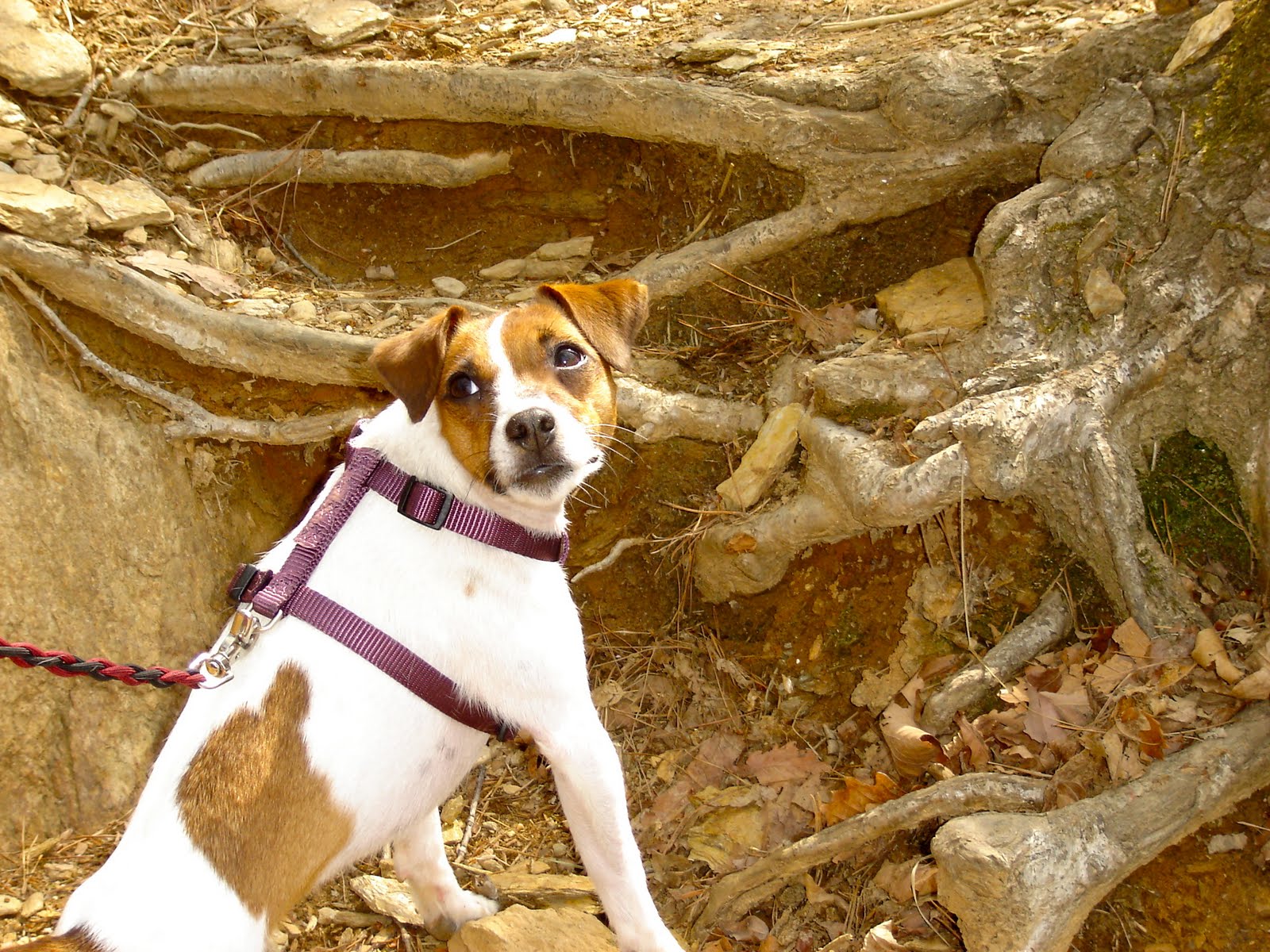
She insists on being out front, both going up and coming down. Today we put her in her flyball harness because the last time we went, she was pulling so hard on her collar that she was choking herself the whole time. She covers each stretch of trail a minimum of three times; racing ahead to the end of her 10' lead, then coming back to hurry us along, then racing out the end again. I have no doubt that without us primates slowing her down she could run to the top and back again twice before we reached the halfway point.

The trail is deeply wooded, insanely steep, and consists mostly of roots and rocks strategically placed to be used as stairsteps. In some more precarious places there are handropes along the sides to keep folks from falling off, but for most of the way up you are on your own. At several points along the way there are scenic vistas, but the view from the top is worth the wait. As you can see here, it's pretty impressive, regardless of which way you look.

This is what Koreans consider a "small rural city." I've tried to explain to my students and our coworkers that Jeonju is a sprawling metropolis compared to Laramie, but they have a hard time getting their heads around the idea of a "city" that is smaller in population than any two blocks of their downtown...

"Hurry up, monkey!"
We have decided to climb this trail several times per week as a part of our exercise regimen. Tomorrow we will climb it in the cool of the morning, and time it to set a baseline. Then with each week we'll see how much faster we can do it. Regardless of how many minutes we shave off our times, I am sure it will never be fast enough for Friday.

It is time for some spicy noodles and a good night's rest. Friday is already crashed out, resting up for tomorrow's climb.

You Might Be a Waygookin* If...

Top ten signs you're living in Korea:

  1. Paying more than five or ten dollars for anything - food, clothes, haircuts, taxis, acupuncture, sex (just kidding) - begins to seem outrageous. Which means that...
  2. When your partner points out a Starbucks, the first words out of your mouth are, "Oh, no. Very expensive."
  3. You eat what your Korean friend describes as "It's like soup, but with syrup, and red beans, and rice cake," and think it's delicious.
  4. Actually, you think everything is delicious. Except for bugs.
  5. You stop making fun of Korean mountains. Sure they're not as big as the Rockies, but those things go straight up - and so do all their trails.
  6. You establish a "Short Skirt of the Day" contest, and argue over the winners.
  7. You didn't order the fried squid and popcorn combo at the movie theater, but you probably will next time.
  8. You get all excited when you see a girl with dyed hair and a facial piercing (because they are SO rare).
  9. "Because it's cute!" becomes a perfectly good reason to buy something.
  10. When your partner tells you that you can't live off of rice cakes, you respond, "But I can try."
*Korean for "foreigner"


Monday, March 21, 2011

3.20.11 Jeonju Facts


It's time for facts about Jeonju City (전주시).

Coordinates: 35°49' N, 127° 09' E 
Population: 649,500 
Elevation: 177 feet


Although Jeonju has been an important population center in North Jeolla Province (전라북도), the modern founding of the city was in 1949. It is a transportation and agricultural center in the heart of the country's most densely populated and richest rice-growing area. Food processing, education, and textile manufacturing are the chief industries, along with the production of paper, plastics, boots, and tires. Its mountaineous location and many historical sites make it a popular hiking destination as well. The city also has a zoo, a large park, and the Samsung Sound and Culture Hall, a large, modern concert complex on the Chonbuk National University Campus.

Other bits of info:

  • Jeonju is famous for bibimbap (비빔밥), a traditional rice dish with vegetables and hot chilli sauce. 
  • Jeonju is divided into 2 wards, Deonkjin-gu (덕진구) and Wansan-gu (완산구), which in turn are divided into approximately 40 neighborhoods.
  • The National Jeonju Museum exhibits ancient relics from the Three Kingdoms Period (57 BC - 668 AD).
  • There are many other museums, as well as temples, a castle fortress on a hillside, and a well-known paper gallery. 
  • The annual paper fashion show is famous throughout Asia. It features both couture and traditional Korean clothing made of paper.
  • The Jeonju Hanok Maeul (한옥마을) is a traditional-style village located in the heart of Jeonju, housing over 800 traditional "hanok" style buildings. It contains many traditional tea shops, souvenir shops, and restaurants.
  • Jeonju is famous for strawberries and exceptional produce.
  • The Jeonju International Film Festival draws about 50,000 visitors annually.