Showing posts with label food. Show all posts

Tuesday, June 21, 2011

6.21.11 How to Get Food in Korea, Part II

Earlier we gave you the run-down on some different kinds of Korean restaurants - now it's time to get to the eatin'.

First thing to do when you walk in the door: scan the room rapidly until you locate an employee, then sing out a nice loud, "Anyong hasseyo!" in their direction. If you can't see an employee, just say the same thing, but louder - someone will usually emerge from a back room. This rule actually applies to any store you enter, not just restaurants. Koreans are a friendly people, and their convenience store employees and waiters generally object to being treated like part of the furniture (this is especially interesting when you cinsider that Korea is a country in which tipping of any kind is usually considered an insult).

Next, find a table. Unless you're eating at an expensive restaurant, you're expected to seat yourself. If you choose to sit at a traditional low table, there is often a little pile of cushions near the wall. Take one and get comfy.

There's either a menu already on the table, or a waiter will bring you one. If it has some English on it, you're in luck! If it's not, look at the walls - lots of restaurants post yummy-looking pictures of food to inspire the appetite, and you can point at what you want and tell the waiter, "Chogo jom jusseyo" (please bring me that). No English and no pictures? Then it's time to play what I call the "The Point at Something Random in the Menu" game. Linus prefers to call it the "I Pointed at WHAT?" game. Just try not to accidentally order anything too expensive.

Don't wait for the waiter to come to you. If you want to order, just raise your hand and say, "Yogiyo!" ("Here!") or "Shillehamnida!" ("Excuse me!"). Some restaurants even come equipped with a little button on the table, which when pressed will automatically summon a waiter, no shouting and gesturing required.

Once you've given your order, you can get your water and silverware. Chopsticks and spoons are located in a box on the table. Water is usually self-service. Look for an office-style water dispenser next to a UV sterilizer full of little metal tumblers. If you are brought water, it's generally in a big bottle, which is nice because you'll have to refill the tiny metal cups about three times during your meal (or, if you're like Linus, you should just sit right next to the water cooler).

After you've ordered, side dishes will be brought to your table. No matter what else comes, there will always be mat (cabbage) kimchi. If you're like us, you'll become a connoisseur of kimchi in a matter of days - I prefer mine spicy, juicy, and with enough fermentation to sizzle a little in the mouth. Also frequently offered are various kinds of fermented radishes, fermented radish tops, small salty fish, a variation on coleslaw with disturbing pink dressing, corn, clear soup, boiled fish paste (much tastier than it sounds), fermented tofu, acorn tofu, dried fruit stuff, bean sprouts, little sausages, sweet pickles, noodle-things, and if you're really lucky, the best, freshest fried eggs you've ever had.

If you spill on yourself while stuffing all this deliciousness in your mouth, you'll need to get your own napkin. Napkins come in dispensers, like tissue. Sometimes these dispensers are on the table, but sometimes they're on the wall, on the other side of the restaurant, and you have to get up and go get one, which can be kind of embarrassing when you've just splattered kimchi all over your white skirt.

Since Linus dumped all the photos of food, I don't have any pretty illustrations for this post. So, um, here is a cute Korean girl.

Thursday, June 9, 2011

6.9.11 Picture Dump

I've been blogging for quite a while now, and this has happened to me before. You take a couple pictures that you want to put up, and you plan to write a really awesome post to go with them... but then you (insert random timesink here). After that is done you want to post, but you have taken several more cool photos, and you have a cool experience to share - you realize it will take several posts. You plan to write three or four posts on the weekend and then schedule them to post every other day for the next week. Naturally, towards the end of the week you find out that (insert cool event you can't possibly miss here) is this weekend, and you put all posting on hold until it is over on Sunday. Sunday rolls around and you are too (drunk/hung over/sunburned/frostbiten/injured/exhausted/pregnant/depressed/etc.) to write. Rinse and repeat once or twice and then you are where we are today - too far behind to ever catch up. The pictures and half-written posts clog up the pipes until you dread going near your computer.

Thus, we dump. Yeah, this is the blog equivalent of your neighbors inviting you to look at their slides from Mazatlan over wine spritzers. Sorry, but if we don't dump these, we'll never be able to face the keys again. Bear with us...

Papbingsu - amazing dessert. Sweet red bean paste, rice cakes, and fruit over shaved ice.  Amazing.

Teriyaki woodong - very tasty, and seriously spicy.

Becky getting her hair washed with water that was steeped with sweet flag leaves. It's for good luck, and it's a major attraction of the annual Dan-o festival. We also entered a wrestling tournament that day - alas, there are no pictures.

"Our" bakery. It's ours because it's by our house, and the lady who works  there in the evenings loves us. She actually hugs Becky all the time. She speaks Korean to us constantly - we are susually reduced to smiling and nodding as she puts free doughnuts into our bag.

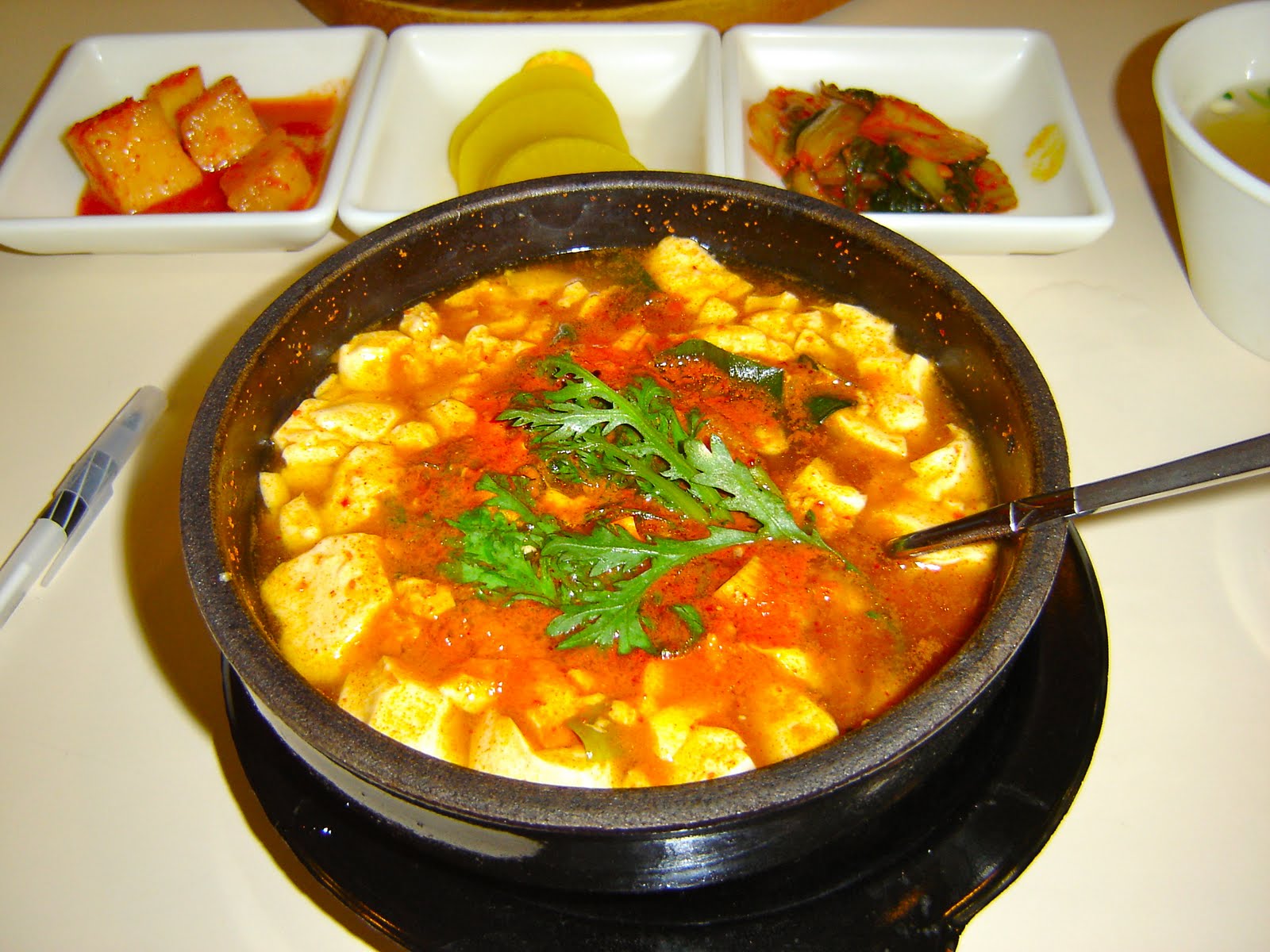
Sinpo soondaboo - the food that is as fun to say as it is to eat. It's tofu, veggies, and a little meat in a spicy chili soup - really good for  chilly mornings.

Choenbuk - the university district. Filled with cool shops, cheap food, and on the weekends, young people dressed to kill. Lots of incredibly pretty girls with amazingly well-dressed boys, strolling.
Dak galbi - chicken, kimchi, rice cakes, and chili sauce, cooked at your table. This is the before picture...

... and this is after it's been cooking for about 10 minutes. It's possibly my favorite thing I've had to eat. Ever.

Dan pat chuk - sweet red bean soup with rice cake in it. It's like a warm pudding, really, with a ton of cinnamon and nutmeg.
Typical lunch. Doekboggi, gimbap, boiled fish paste, and (sigh) a corn dog for Becky.
Lotus leaf rice - the green thing that looks like paper is a lotus leaf . The rice comes to the table wrapped up in it - looks like steaming green baseballs. Delicate flavor - very different.
Pork Bulgogi - very hot, in both spiciness and temperature. Surrounded by some of the side dishes that came with this meal...
...more side dishes...
... and still more side dishes. This meal was incredible, and it was about $9.00 per person!
Our coworker, looking radiant on her wedding day.
Pumpkin roll - Becky's new favorite sushi.
Spicy bacon roll - the name meant I had to taste it. You'd be surprised how well bacon and tuna go together.
Seafod dupahb - basically a seafood omelette over rice. Very satisfying comfort food.

And finally, Star Trek Becky.

Ok, I feel better now. I think we can return to regular posting again.

Saturday, May 14, 2011

5.14.11 We're Legal! Also, More Food...

We haven't done a documents post in a while, because the majority of the paper chase happens before you get to Korea. There are, however, a few other documents you'll want to get once you arrive.

You are required to undergo a health check within 30 days of arriving. Our handler, the indispensabe Kate, was very proactive on this, and we went in for our tests during the first week that we were here. It was a very basic physical; blood and urine samples, height, weight, pulse, blood pressure, eye test, and chest x-ray. Unfortunately, the clinic we went to first was not certified for government health checks, so we had to go do it all again about 10 days later. The second time they did all of the above plus hearing and color-blindness tests. I failed the color-blindness test utterly (in fact, I failed it so soundly that I think it is actually a cruel joke. There is no number in the dots, and everyone is in on it but me. You guys are mean...).

While we were waiting for the results of those tests, our employers did criminal background checks through Korean law enforcement and Interpol. Luckily, Becky's sordid past as a black market mongoose wrangler didn't surface (thank goodness for the witness protection program).

Once all of those checks came back negative, we were issued our "Certificate of Alien Registration" cards. With these in hand, you are ready to take the final step in becoming a fully functional hangul-illiterate waygookin - which is having someone who speaks Korean take you to the bank so you can set up an account. Kate and the director of our hogwan took us to Joenbuk Bank today, so we can now be paid for our endeavours via direct deposit. You can see our alien cards, debit cards, and passbooks (they still use passbooks here!) in this picture, along with a beautiful fan that Becky got on our last trip to the Hanok Village.

Now, on to the part of the post you are all actually interested in - food. We have a lot of catching up to do, so here goes (all of the pictures will enlarge when you click them once or twice).

Here is another chigae (stew), but this one has pork-filled mandu (dumplings) in it. Like everything here, it is served insanely hot - usually still boiling when it reaches the table (my Aunt Susan would love this tradition). The dolsot (thick-walled stone bowl) that it's served in really holds the heat. We often have to wait 5 minutes or so before we can even try to eat it. Luckily, they always serve several side dishes with every meal. In this picture we have two kinds of pickled radish and kimchee (of course). This is a perfect dish for a rainy day, and our local gimbap shop serves a big bowl of it for 3500 Won ($3.21). I eat some kind of chigae about once per week.

This is a Korean omelette. The red sauce on it is just ketchup, but the filling is a bit of a surprise - spicy fried rice, bell peppers, and, of course, kimchee. Like everything else I've had in Korea, it is served quickly, and well prepared. Although it looks very large, the eggs are spread very thin during cooking; my guess is that it only contains 2 eggs. Whenever I get the urge for breakfast foods, this is the solution. If you are squeamish about trying new foods, I recommend this one. It is quite similar to omelettes in the West, and a gentle introduction to Korean ideas about spiciness. The texture is just like the omelettes at your local Waffle House, but less greasy.

Another good choice if you're not excited about jumping right into the deep end of Korean cuisine is pizza. It's like American pizza, but the crust is a bit softer and sweeter - many have sweet potato in them. This one is a bulgogi (beef barbecue) pizza with "cheese bites" in the crust. It was delicious, although it was a bit more expensive than the usual pizza here - it was 12,500 Won ($11.46). We had this for dinner the other night, and there were no leftovers at all. It is a nice combination of Korean and American cuisine, without ruining either set of flavors. When you are missing Pizza Hut, this is a good solution (there is Pizza Hut in Korea, but it is quite a bit more expensive).

This is the fried chicken I mentioned in an earlier post. It comes from BBQ Chicken, a chain here in Korea, and it's a bit like the sesame chicken you would get at a chinese place in the States, but with more fire to it. Sweet and spicy, with a lovely crunchy texture, it is served with a side of pickled melon - a remarkably good combination. They carve chickens differently here, however, so the only pieces that are immediately recognizable are the legs. They tend to chop breasts and thighs in half, so you get some odd little pieces, but all are delicious. This has forever supplanted KFC, Church's, and Popeyes in my heart.  It's not a food you can be dainty while eating - it requires many wet naps to clean up your fingers afterward.

The dish that Jeonju is famous for, bibimbap, is available all over the place, and it is amazing. The dolsot version has a raw or nearly raw egg added to it just as it is served, and the hot bowl cooks the egg. This particular batch came from our favorite little gimbap shop and it is not served in the dolsot, so the egg is fried, sunny side up. It is a lovely presentation when it hits the table, but I didn't remember to take a picture before Becky started stirring it. You are seeing here it as it looks while you're eating it. Very yummy, and quite good for you, too, or so our boss believes. She is quite motherly, and wants us to eat more vegetables...

I saved this one for last, so that the more squeamish readers could just turn away. This is Soondae. It's a sausage made by stuffing pig intestines with noodles, then soaking it in pig blood and spices. You boil it in a salty brine until it is an alarming purplish black, then serve it with slices of pig organ meat - heart, liver, kidney, and some other bits I couldn't identify. All of this is salted and dipped in a sweet/hot chili sauce. This is drinking food, Korean style. It goes well, I am told, with both beer and hard liquor, and it is a staple of the late night crowd. I have had it twice - the first time was not great, but the second time I finally figured out how you are supposed to use the salt (that's what the foil packet contains) and sauce, and it was delicious. Almost as alarming to look at as the cup o' bugs, but much tastier. Friday is a huge fan of the kidney bits.

Wednesday, May 11, 2011

5.11.11 One Month

UPDATE: Blogger dropped this post, and the lovely comments that went with it. I'm trying to put it back together from an earlier draft, but your comments are gone - sorry!


We have officially been in Korea for one month now. Here is what we have learned so far.


1) Don't come to Korea if you have a seafood allergy.  If it doesn't have seafood in it, it has seafood on it or next to it. Failing that, it was at least stirred with the same spoon as seafood, somehow. This is, after all, a country in which "boiled fish paste" is a staple. 


2) Don't come to Korea expecting it to be like America, but in a different language.  Based on what we have heard about other ESL teachers, the "Ugly American" is alive and well in Korea. Here's a tip for those of you considering an ESL job - the food in Korea is different. So are the apartments. And the bathrooms. And, like, almost EVERYTHING. So if you are not amenable to change, stay home - stop making the rest of us look bad.


3) Don't come to Korea expecting it to be a third world country.  They have some of the fastest internet in the world, well-developed public transportation in most cities, and two cell phone stores on every block (I think that one's a law or something...). Many of their social programs far exceed those offered in the U.S., and their education system is kicking ours in the pants on a daily basis. They dress better than us, eat better than us, and live a bit longer, too. Also, Koreans are not ignorant of the fact that some Americans see Korea as a backwater, and they get offended if you treat them as if it is. Believe me, they speak more English than you speak Korean, so be polite.


4) Small children and dogs are the same everywhere.  They are a pretty consistent source of delight, and often the best avenue for first contact with adults. If you make friends with the dogs and the kids, the adults are more likely to chat with you.


5) Having a small face is a big deal in Korea.  By any beauty standard Becky is easy on the eyes, but by Korean standards she is cuter than kittens in a yarn factory. Strangers frequently tell her in glowing terms what a small face she has, and she hears daily (literally, daily) that she is 예쁜("yep pun" pretty). In addition to a small face, pale skin, gothy wardrobe, and being a C-cup doesn't hurt...


6) Nascar should inport Korean taxi drivers.  In the U.S. they say "rubbin' is racin'." In Korea, that's just a trip to the supermarket. I have a lot of windshield time, some of it at pretty high speeds, and these guys give me grey hair. When caught behind a line of cars at a stop light it's common for them to shift over to the parking lane, roll past all the cars waiting and then race ahead of them when the light changes. Left turns on red and splitting lanes are not unusual, and u-turns can be made anywhere, without braking. That said, I will give them credit for honesty - not one cab driver has tried to drive us around to run up the meter. 


7) Koreans won't ask you if you want something to eat.  They usually just hand you something and say, "here, eat this." They are generous to a fault. We feel guilty about how much our boss and coworkers feed us. In fact, our boss is worried that we arent eating enough, and she is constantly asking what we had for breakfast. She has no idea how much healthier our diets are here than they were in America - I've eaten more fresh, well-prepared vegetables in the last month than I did in the previous decade living in Laramie. 


8) A 요 ("yo" Korean mattress) is the most confortable bed I've ever had.  A yo is basically a pad that goes on the floor - no frame, no box springs, and it folds or rolls up when not in use. Ours is latex foam, but you can find them filled with a number of different things, from cotton to red soil (it's supposed to be very good for your health). What makes it so lovely is that it goes directly on the ondol (heated floor). On chilly nights your comforter traps the heat from the floor, keeping you toasty. Which leads us to #9...


9) Don't forget to turn off the heated floor before you leave for work.  The floor is heated by the same system that makes hot water for showers and dishes. It's an on-demand system, so you turn it on when you want hot water, then turn it off when you're done. If you leave it on all day (like we did today) the floor and room get very hot, and you come home to an 85 or 90 degree apartment. Our cat thinks it's awesome - she was sprawled in the middle of the warmest spot like a puddle of fur. 


10) Korean children find me fascinating.  The kids here are generally very sweet, and like all children, they can be charmingly blunt. One of the first days I taught, a pack of litle girls (ages 5-7) surrounded me and started petting my arms while chattering loudly in Korean. One of them looked up at me while tugging gently on my armhair and said, "what?" This is how our littlest students usually ask "what is the English word for this?" Without much thought I said, "fuzzy." They found this word unbelievably hilarious, and almost everyday one of these little girls will pet me while saying "fuzshy" (they have trouble with Z and S sounds).

One of the boys I teach (about 11 years old) looked at my blue eyes very intensely one day and said, "wow, like the ocean!" This lead to all of the kids getting out of their chairs and surrounding my desk so that they could look at my eyes very closely.

Two nights ago I got the most amazing fried chicken on the way home (part of another post, soon). While we waited for it (because like virtually all food in Korea, it was made fresh when we ordered it - I haven't seen a single heat lamp since we got here) there were 4 little girls in the restaurant. They were the owners/employees children, and they all looked to be sisters or cousins, ranging from about 4 to about 8 or 9. We had our dog, Friday, with us, and they were all enthralled with her. While the older kids played with her and fed her treats, I sat down on the curb. After a few minutes, the youngest girl decided that I was ok, and came and climbed into my lap. She, too, petted the hair on my arms, measured how big my hands are compared to her own, and basicaly made me her personal jungle gym. When her mother (or maybe it was her aunt) came out to give us our order she refused to get off my lap so that I could leave, doing that dead weight thing that kids do, while giggling. So cute!

There was an 11th point on this list, but Blogger decided to lose this post and the only draft I have saved is this one. That bit of wisdom will just have to come up again in a later post (especially since I can't recall now what it was...).

Sunday, May 1, 2011

How to Get Food in Korea, Part 1

Food is everywhere in Korea. You are going to want to try some. Here's how.

Different Kinds of Food

We have spotted several varieties of food shops in Jeonju.

Basic Korean Restaurant - The size of the average Korean restaurant ranges from small to downright hole-in-the-wall. Our favorite falls in the hole-in-the-wall category, seats about eight people, and is much beloved for its speedy service, fantastic food, and resident adorable baby. At the average Korean restaurant, even if you can't read the menu, you can safely order: gimbap, the Korean version of sushi; bibimbap, a rice and vegetable dish that's as tasty as its name is fun to say; and kimchi jigae, a fabulous soup that contains kimchi, a little pork for seasoning, and a lot of chili paste. Prices will range from 4,000 won to 8,000 won per person, so the basic Korean restaurant is dead cheap.

Kimchi jigae. It is the bomb.

Traditional Restaurant - This is easy to spot. If you look through the window and the tables are about a foot off of the ground and everyone is sitting on the floor, it's a traditional-style restaurant. Some restaurants use a mixture of Western- and Korean-style seating - in this case, the traditional seating will almost always be on an elevated wooden platform. Before entering a traditional seating area (or the whole restaurant if it's all traditional-style), take off your shoes. If you're not accustomed to sitting on the floor, be sure to change position often, otherwise your leg will probably fall asleep (mine always does). Serves the same food at the same prices as the Basic Korean Restaurant, but you can also get a more elaborate meal of bulgogi.

Bulgogi is frequently crazy big. It is often cooked on a burner set in the table, and the wait staff will come by and stir it for you periodically until it's done. While you wait, you can munch on the five to twenty-five side dishes (I am not exaggerating) that come with it. Most are kimchi-esque things, but occassionally you will get something a bit more challenging like dried bay shrimp (crunchy) or pickled eggs and onions (oddly sweet). Once the main dish is done, you scoop it into lettuce leaves and add condiments. This is a serious meal - set aside an hour or more, and wear lose pants.

Fried Things Shop - Also known as "Things-On-a-Stick Shop." This sort of shop will always have either pictures of fried things in the window, or the actual fried things. Our personal Fried Things Shop offers squid-on-a-stick, chicken-on-a-stick, noodles wrapped in seaweed and fried, rice cakes in red sauce, fried hard-boiled egg, various other unidentifiable fried things, and my favorite, double-breaded corn dog. On a stick, of course. Most of these shops also serve non-fried things and have a few tables in the back for those who want to sit and eat, but don't mistake it for a basic Korean restaurant, as they will look at you like a crazy person if you walk into a Fried Things Shop and ask for bulgogi. Most things cost about 1,000 or 2,000 won, so if you're long on hunger and short on won, this is the place to go. Over the long haul, though, your cardiologist might disagree.

Snack Shop/Coffee Shop - Similar to the Fried Things Shop, but offers fewer fried things and more sandwiches, desserts, and coffee.

Full-Service Coffee Shop - Just like in the West, except that here they probably serve patbingsu, an incredible confection of ice cream, red beans, fruits, cornflakes, rice cake, and ice that should be introduced in the U.S. immediately. Some will also serve dan-pat-chuk, a warm, sweet, red bean soup that is perfect for slightly cold days. Or slightly hot days. Whenever, really. Coffee shops can be pretty expensive, so it's best to limit visits.


Rice Cakes Shop - My personal favorite! Easily identifiable by the outside table covered in packages of rice cakes. If you've ever had mochi, you have some idea of what a Korean rice cake is like. If not, then the picture to the left should give you some idea.
Fillings range from red bean to cinnamon sugar to weird savory things that Linus and I generally don't care for. Since I have post-meal rice cake cravings every day, we go to this kind of shop a lot. A package of eight or ten big rice cakes or a gazillion little ones costs about 2,000 won.

Bakery - Bakeries are hot in Jeonju at the moment. We have a bakery in our neighborhood, and there's a chain bakery called Paris Baguette on our route to work, so we've had plenty of opportunities to do a little taste-testing. All the breads are really fresh and good, but it's the desserts that will blow your mind. Also, the variations on what I like to call "hot dog bread" - that is, bread in which hot dogs or sausage are incorporated in some way - can get pretty interesting. Prices in these range from less than 1,000 won to about as high as you want to go.

Street Food - Basically Fried Things Shops on wheels, these stands offer about the same fare as the FTS, but possibly at slightly higher prices.

Pizza and Chicken Shops - These are specialty shops. The chicken shops are expensive - about 12,000 to 16,000 won a bucket - but the pizza shops are quite reasonable. The pizza here is pretty different from home and probably tastier. I sure wouldn't trade my Korean sweet potato pizza for some Little Ceaser's (at least, not yet).

Fancy Restaurants - We haven't been to many of these, but we know they exist because our director bought us lunch at one. Prices are high, but the food is unique and excellent, so if you've got money to burn they're worth a visit.

Western Chains - They exist, but why would you go?

Despite all this fabulous food at low prices, Linus is losing weight. I am not, because I inhale rice cakes like oxygen. But I can still fit into wee Korean sizes, as I will demonstrate in the next post!

Monday, April 25, 2011

You Might Be a Waygookin* If...

Top ten signs you're living in Korea:

  1. Paying more than five or ten dollars for anything - food, clothes, haircuts, taxis, acupuncture, sex (just kidding) - begins to seem outrageous. Which means that...
  2. When your partner points out a Starbucks, the first words out of your mouth are, "Oh, no. Very expensive."
  3. You eat what your Korean friend describes as "It's like soup, but with syrup, and red beans, and rice cake," and think it's delicious.
  4. Actually, you think everything is delicious. Except for bugs.
  5. You stop making fun of Korean mountains. Sure they're not as big as the Rockies, but those things go straight up - and so do all their trails.
  6. You establish a "Short Skirt of the Day" contest, and argue over the winners.
  7. You didn't order the fried squid and popcorn combo at the movie theater, but you probably will next time.
  8. You get all excited when you see a girl with dyed hair and a facial piercing (because they are SO rare).
  9. "Because it's cute!" becomes a perfectly good reason to buy something.
  10. When your partner tells you that you can't live off of rice cakes, you respond, "But I can try."
*Korean for "foreigner"


Thursday, April 21, 2011

4.20.11 Eating Constantly


I expected to experience massive culture shock in Korea. Instead, I have been pleasantly surprised by how much I feel at home here. It took me a few days to figure out why, but it's the food. It's not that the food is familiar (it's definitely not) - it's the attitude about food that feels just like home.

By home, I don't mean Wyoming; I mean my childhood home, the South. Just like there, people here are always planning their next meal, discussing their last meal, and making sure that everyone around them has eaten. Our boss has bought lunch or dinner for the teachers at our hogwan almost every day since we arrived, and our liason and translator, Kate, asks almost daily if we are eating enough, if we need more groceries, and what we had for each meal. My students come in with treats frequently, and they share everything. Today I was walking down the stairs and one of the younger boys I teach (he's about 9 years old) stopped me to give me a bit of the sweet bread he was eating.

The way it's presented makes it hard to refuse - they don't say, "would you like some?" They say, "here, eat this." If you refuse, then they immediately try to find something else that you will eat, as if the reason you refused is because of an allergy or some religious restriction, not that you are simply full. It's charming and endearing - it creates friendships in record time.

The two ladies shown here are our Korean coworkers, Scarlet and Lucy. This picture was taken today at (yet another) lunch that our boss bought for us all. They are both very sweet; Lucy is very shy and quiet, while Scarlet is the "party girl" of the office - she told us that she was out drinking until 4am last night with her "oppa" (boyfriend). These two teach English phonics, vocabulary, and grammar, but their classes are taught mostly in Korean (even though both speak English pretty well). They give the kids the foundations in English that they need to then take classes taught by us. In our classrooms there is an "English only" policy, at least for the older, more advanced students. They have to ask for permission to speak Korean, or to use a Korean/English dictionary (which they all have on their cellphones).

This is Kate, our liason. She is the daughter of our boss, the director of the school. She is quite fluent in English, and she has been completely indispensable to us during our settling in process. Whenever there are forms to be filled out, arrangements to be made, or customs to be explained, Kate is our go-to girl. She is remarkably organized for a woman of 21, and she has handled our paperwork like a pro. Without Kate, this past week would have been very rough - impossible, actually.

She and Becky have really hit it off. They have a movie and shopping date planned for this weekend (I am invited, but I refuse to go see another damn version of "Jane Eyre"). I imagine that through girl bonding they will happily do significant damage to each others' bank accounts in the coming months.

Next post - pictures from our first weekend in Jeonju!

Thursday, March 17, 2011

3.16.11 Dolsot Bibimbap

There are many things we are looking forward to in Korea, but the food is very high on the list. Jeonju is known for its cuisine, and it is also known as "the hometown of bibimbap." Bibimbap is a traditional dish made with meat, egg, and fried vegetables on a bed of rice with pepper sauce. Dolsot bibimbap is served in a heated stone or iron bowl so it continues to cook at the table - in this version the egg is sometimes put on raw, and it cooks as you stir it in. This dish is one of the first things we plan to try once we get there!